GOD is a cute acronym
Phonograph <= =>axiomatic system for number theory
low-fidelity phonograph <= =>"weak" axiomatic system
high-fidelity phonograph <= =>"strong" axiomatic system
"Perfect" phonograph" <= => complete system for number theory'
Blueprint" of phonograph <= => axioms and rules of formal system
record <= => string of the formal system
playable record<= => theorem of the axiomatic system
unplayable record <= =>nontheorem of the axiomatic system
sound <= =>true statement of number theory
reproducible sound <= => 'interpreted theorem of the system
unreproducible sound <= => true statement which isn't a theorem:
song title <= =>implicit meaning of Gödel’s string
there are some interesting analogies btwn koans / the puzzles (six boxes | six boxes) / floop algs
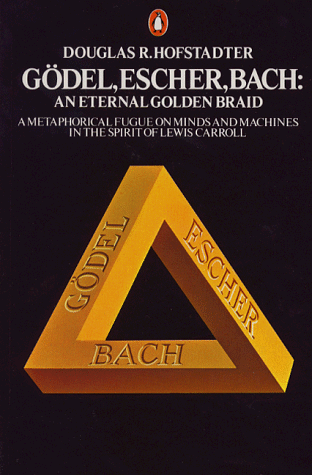
Gödel, Escher, Bach by Douglas R. Hofstadter is the most awesome book that I have ever read. If there is one book that emphasizes the tragedy of Death, it is this book, because it's terrible that so many people have died without reading it.
nice review: If there is one book that emphasizes the tragedy of death, it is this book, because it's terrible that so many people have died without reading it.
One is given the string MI and their goal is to transform it into MU. They can do so using only the following rules.
Rule 1. xI to xIU—add a U to the end of any string ending in I.
Rule 2. Mx to Mxx—double the string after an M
Rule 3. xIIIy to xUy—replace any III with a U
Rule 4. xUUy to xy—remove any UU
“Of course, there are cases where only a rare individual will have the vision to perceive a system which governs many peoples lives, a system which ha never before even been recognized as a system; then such people often devote their lives to convincing other people that the system really is there and that it ought to be exited from!”
“Tortoise: Curious that you should think so ... I don't suppose that you know Godel's Incompleteness Theorem backwards and forwards, do you?”
“Hofstadter's Law: It always takes longer than you expect, even when you take into account Hofstadter's Law.”
“Thus, in the brain of a native speaker of English, "slithy" probably activates such symbols as "slimy", "slither", "slippery", "lithe", and "sly", to varying extents. Does "lubricilleux" do the corresponding thing in the brain of a Frenchman? What indeed would be "the corresponding thing"? Would it be to activate symbols which are the ordinary translations of those words? What if there is no word, real or fabricated, which will accomplish that? Or what if a word does exist, but is very intellectual-sounding and Latinate ("lubricilleux"), rather than earthy and Anglo-Saxon ("slithy")? Perhaps "huilasse" would be better than "lubricilleux"? Or does the Latin origin of the word "lubricilleux" not make itself felt to a speaker of French in the way that it would if it were an English word ("lubricilious", perhaps)?” similar to squi words??
Tortoise: Say, speaking of birthdays, today is MY' birthday!
Achilles: It is?
Tortoise: Yes, it is. Well, actually, it's my uncle's birthday, but that's almost the same.
"[T]here is no such thing as an in coded message. There are only messages written in more familiar codes and messages written in less familiar codes”
An amusing way to see the incorrectness of Lucas' argument is to translate it into a battle between men and women ... In his wanderings, Loocus the Thinker one day comes across an unknown object-a woman. Such a thing he has never seen before, and at first he is wondrous thrilled at her likeness to himself: but then, slightly scared of her as well, he cries to all the men about him, "Behold! I can look upon her face, which is something she cannot do-therefore women can never be like me!" And thus he proves man's superiority over women, much to his relief, and that of his male companions. Incidentally, the same argument proves that Loocus is superior to all other males, as well- but he doesn't point that out to them. The woman argues back: "Yes, you can see my face, which is something I can't do-but I can see your face, which is something you can't do! We're even." However, Loocus comes up with an unexpected counter: "I'm sorry, you're deluded if you think you can see my face. What you women do is not the same as what we men do-it is, as I have already pointed out, of an inferior caliber, and does not deserve to be called by the same name. You may call it `womanseeing'. Now the fact that you can 'womansee' my face is of no import, because the situation is not symmetric. You see?" "I womansee," womanreplies the woman, and womanwalks away .. . Achilles: What? Oh, yes-skeptical. Well, of course I am. You don't think I believe that Mr. Crab got such a letter, do you? I don't fall for just anything, you know. So it must have been 5'ou, Mr. T, who received the letter! Tortoise: Oh, no, Achilles, the part about Mr. C receiving the letter is quite true. What I meant was, aren't you skeptical about the content of the letter-its extravagant claims? Achilles: Why should I be? Hmm ... Well, of course I am. I'm a very skeptical person, as both of you should well know by now. It's very hard to convince me of anything, no matter how true or false it is. Tortoise: Very well put, Achilles. You certainly have a first-class awareness of your own mental workings. Achilles: Did it ever occur to you, my friends, that these claims of Najunamar might be incorrect?
“He must have some amazing and inscrutable Oriental type of insight which we here in the Occident can have no inkling of.”
“What is so bad about reproducing the Epimenides paradox? Is it of any consequence? After all, we already have it in English, and the English language has not gone up in smoke”
“That they appear here out of context is not too misleading, since their proper context sounds just the same as they do.”
Crab: I believe it's Home Team versus Visitors. Oh, no-that was last week. I think this week it's Out-of-Towners.
Achilles: I'm rooting for Home Team. I always do.
Sloth: Oh, how conventional. I never root for Home Team. The closer a team lives to the antipodes, the more I root for it.
Achilles: Oh, so you live in the Antipodes? I've heard it's charming to live there, but I wouldn't want to visit them. They're so far away.
Sloth: And the strange thing about them is that they don't get any closer no matter which way you travel
Tortoise: Subjunctive instant replays are a little unusual, aren't they?
Crab: Not particularly, if you have a Subjunc-TV.
Achilles: Is that one grade below a junk TV?
“In everyday thought, we are constantly manufacturing mental variants on situations we face, ideas we have, or events that happen, and we let some features stay exactly the same while others "slip". What features do we let slip? What ones do we not even consider letting slip? What events are perceived on some deep intuitive level as being close relatives of ones which really happened? What do we think "almost" happened or "could have" happened, even though it unam- biguously did not? What alternative versions of events pop without any conscious thought into our minds when we hear a story? Why do some counterfactuals strike us as "less counterfactual" than other counterfactu- als? After all, it is obvious that anything that didn't happen didn't happen. There aren't degrees of "didn't-happen-ness". And the same goes for "almost" situations. There are times when one plaintively says, "It almost happened", and other times when one says the same thing, full of relief. But the "almost" lies in the mind, not in the external facts.”
I believe that "almost" situations and unconsciously manufactured subjunctives represent some of the richest potential sources of insight into how human beings organize and categorize their perceptions of the world. An eloquent co-proponent of this view is the linguist and translator George Steiner, who, in his book After Babel, has written:
Hypotheticals, 'imaginaries', conditionals, the syntax of counter-factuality and contingency may well be the generative centres of human speech .... [They] do more than occasion philosophical and grammatical perplexity. No less than future tenses to which they are, one feels, related, and with which they ought probably to be classed in the larger set of ,sup positiona Is' or 'alternates', these 'if' propositions are fundamental to the dynamics of human feeling ....
Ours is the ability, the need, to gainsay or 'un-say' the world, to image and speak it otherwise .... We need a word which will designate the power, the compulsion of language to posit 'otherness' .... Perhaps 'alternity' will do: to define the 'other than the case', the counter-factual propositions, images, shapes of will and evasion with which we charge our mental being and by means of which we build the changing, largely fictive milieu of our somatic and our social existence ....
Finally, Steiner sings a counterfactual hymn to counterfactuality:
It is unlikely that man, as we know him, would have survived without the fictive, counter-factual, anti-determinist means of language, without the semantic capacity, generated and stored in the 'superfluous' zones of the cortex, to conceive of, to articulate possibilities beyond the treadmill of organic decay and death.
Forced matches, analogies, and metaphors cannot easily be separated out.
This should not be taken as an antireductionist position. It just implies that a reductionistic explanation of a mind, in order to be comprehensible, must bring in "soft" concepts such as levels, mappings, and meanings. In principle, I have no doubt that a totally reductionistic but incomprehensible explanation of the brain exists; the problem is how to translate it into a language we ourselves can fathom. Surely we don't want a description in terms of positions and momenta of particles; we want a description which relates neural activity to "signals" (intermediate-level phenomena)-and which relates signals, in turn, to "symbols" and "subsystems", including the presumed-to-exist "self-symbol". This act of translation from low-level physical hardware to high-level psychological software is analogous to the translation of number-theoretical statements into metamathematical statements. Recall that the level-crossing which takes place at this exact translation point is what creates Godel's incompleteness and the self-proving character of Henkin's sentence. I postulate that a similar level-crossing is what creates our nearly unanalyzable feelings of self.